In wine, the number of producers working on lower-impact winemaking grows every year. Organic farming, biodynamics, published carbon footprints — these have already become part of why a bottle gets chosen.
In sake, that work has only just begun.
Sakura Sake Shop has been exporting Japanese sake for more than ten years. Our stated vision is to keep this sake culture alive a hundred years from now, and for a company with that vision, brewing a sake that is both sustainable and good enough to stand in front of the world has been a long-held ambition.
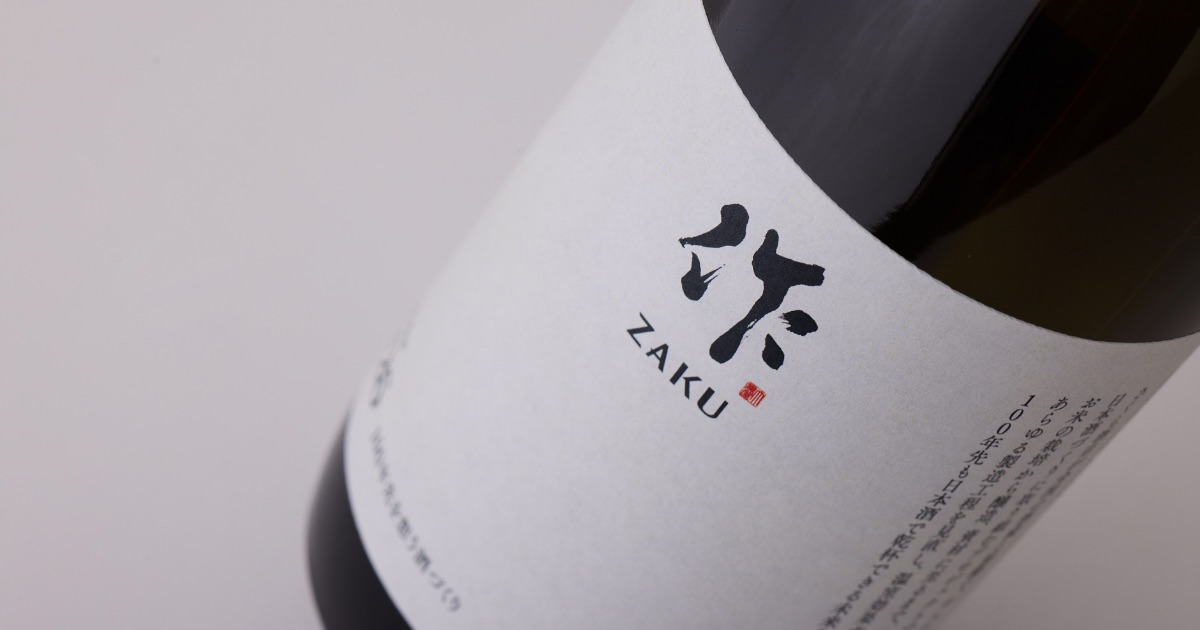
That ambition became the SAKE for 2126 project, and its first release: ZAKU for 2126 Junmai Daiginjo.
This article sets out what a sustainable sake actually is, and what Zaku for 2126 did — and by how much it reduced — with the numbers attached.
What Makes a Sake Sustainable: “Being Mindful” and “Measuring” Are Not the Same Thing
Saying you are mindful of the environment and measuring how much you are actually burdening it are two completely different things.
The first can be said without any evidence behind it. The second requires paying to have the measurement done.
What buyers and retailers overseas — in Europe above all — are asking for is the second. To put a product into their own sourcing criteria, they need grounds they can explain.
So this is how Sakura Sake Shop defines a sustainable sake:
- It is measured — greenhouse gas emissions are quantified across every stage of production
- It is reduced — having measured, the producer can explain specifically what was changed and where
- No compromise on taste — quality has not been sacrificed in the name of sustainability
The third is the important one. Miss it and the sake will not, in the end, keep being chosen. Not “I bought it because it is good for the environment,” but “I bought it because it tastes good, and it turned out to be good for the environment too.” Without that order, you cannot build a product that lasts a hundred years.
Why Sustainable Sake Is Difficult to Make
In sake, the act of raising quality itself pushes environmental impact upward. We think that is one reason sustainable sake has been so slow to appear.
1. The more you polish, the more rice is lost
Sake is made by milling rice away. A junmai daiginjo must have more than half of each grain removed, which means the more premium the sake, the more rice is needed to make a single bottle.
And more rice used means more methane released from the paddies where that rice was grown.
The result is that the more you set out to make a fine sake, the heavier the environmental load becomes.
2. The more you protect quality, the more electricity you use
Sakura Sake Shop recommends storing sake at minus 5°C. It is the coldest sake can be held without freezing, and the state in which quality is best preserved. This is covered in Sake Storage Temperature: What Wine Importers Need to Know.
The other side of that is more electricity than an ordinary refrigerator uses. Shipping is the same: a reefer (refrigerated) container takes more energy than a standard one.
Which is precisely why we feel the need to put that much more into making sake sustainably.
When something like minus 5°C is non-negotiable for the sake of quality, you need to know accurately where you can reduce without giving that up.
So we started by measuring, rather than by guessing.
ZAKU for 2126 Junmai Daiginjo: 540 Days in the Making
“We want to make a sake that is kind to the planet and still good enough to impress the best palates in the world.”
The brewery that answered that brief was Shimizu Seizaburo Shoten, ranked No. 1 in the 2019 World Sakagura Ranking. As the maker of the brand Zaku, it holds a long list of awards from competitions in Japan and abroad.
The project started in November 2024. From there it took around a year and a half — 540 days — to reach a finished product.
ZAKU for 2126 Junmai Daiginjo is built on three commitments:
- Kind to the body — light on its feet and easy to drink through a meal, built for the way people eat today
- Kind to the planet — lower environmental impact, toward a sustainable way of brewing
- No compromise on taste — quality is not sacrificed for sustainability
First: Measuring Where the CO2 Actually Comes From
For Zaku for 2126, we commissioned Zevero, an independent third party, to measure the greenhouse gases emitted across every stage — from growing the rice through brewing and materials — expressed as CO2, making the carbon footprint visible.
Zevero is a “next-generation sustainability partner” that combines AI and sustainability expertise to measure the CO2 emissions of a product and support reducing them.
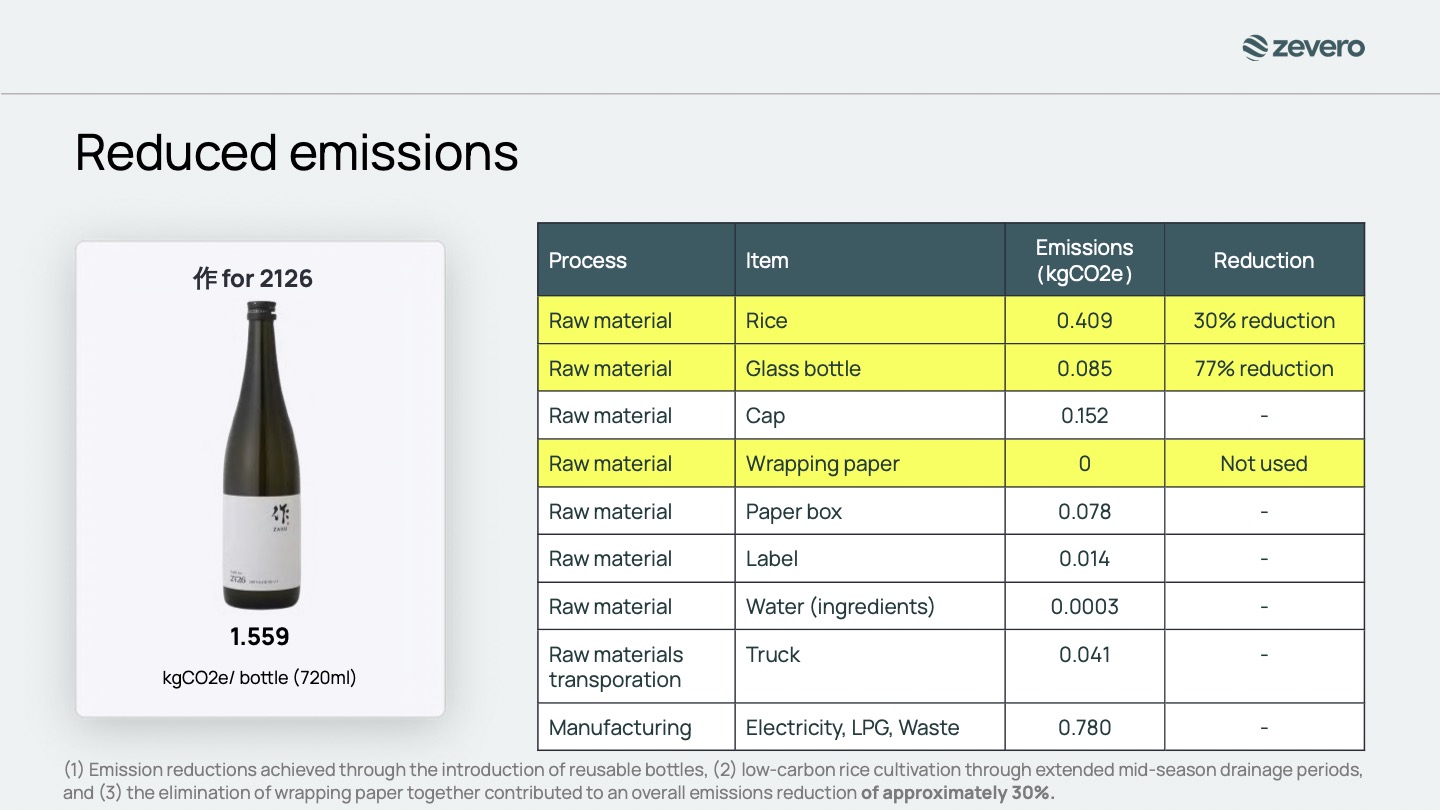
What the measurement showed was that the main sources of emissions were rice and the bottle.
This is the starting point for building a sustainable product — and because proper measurement costs money, it is also the single biggest hurdle to making one.
Rice: Extending the Mid-Season Drainage to Suppress Methane
Methane is released from the soil of the paddies where the rice is grown. As a greenhouse gas, methane is generally put at more than 25 times as potent as CO2.
Working with Kamio Farm, a contract grower local to the brewery in Suzuka, Mie, the period of naka-boshi — the mid-season drainage, when the water is drawn off the paddy — was extended to more than two weeks. That substantially suppresses the methane released from the soil.
The rice itself is Kaminoho, a sake rice specific to Mie Prefecture.
The Bottle: A Reusable One, and the Things We Removed
The other source was the bottle and the materials around it.
- Switching to a reusable bottle
- Printing labels with non-VOC inks (inks containing no volatile organic compounds)
- Removing the gift box and the paper packaging
Together these delivered a reduction of approximately 30% in CO2 across the product as a whole.
No Compromise on Taste: The Case for 13%
ZAKU for 2126 Junmai Daiginjo is built at 13% alcohol.
Even at that lower strength, it keeps the expressive aroma Zaku is known for, finished to be light and easy to keep drinking. On the Sake Matrix it sits at Modern-Light: melon and lychee on the nose, with a juicy sweetness, fresh acidity and a faint bitterness layered over it. Opened, it is fresh and taut; over the following days it rounds out and the sweetness fills in.
The toji himself was satisfied with it — a sake we can recommend with confidence.
Serve at around 5°C, in a white wine glass.
How to think about sake flavor in general is covered in What Does Sake Taste Like?
The light build is not only for the sake of the environment. With demand for lower-alcohol drinks rising worldwide, 13% also makes it easier to drink and easier on the body.
For a Toast a Hundred Years from Now
The label carries not the year it was made, but a year in the future: 2126.
Japan's breweries today face a shortage of rice, a shortage of people, and shifting environmental and market conditions. On the current path, sake a hundred years from now may be a luxury only a few people get to enjoy.
ZAKU for 2126 Junmai Daiginjo is the first release of SAKE for 2126, a project meant to break that pattern and carry sake culture into the future. It exists because of the understanding and cooperation of many people, the brewery and the farmers first among them.
We see it as a small but real step toward a future in which people are still raising a glass of sake in a hundred years.
Summary
- A sustainable sake meets three conditions: it is measured, it is reduced, and there is no compromise on taste
- In sake, raising quality can raise environmental impact (more polishing means more rice; protecting quality means more electricity). That is why it has to start with measurement
- ZAKU for 2126 Junmai Daiginjo was measured across every stage by the independent third party Zevero, and cut CO2 by approximately 30%
- The main sources were rice and the bottle. Extending the mid-season drainage suppressed methane; a reusable bottle, non-VOC inks and removing the gift box did the rest
- 13% alcohol. A light build that also meets rising demand for lower-alcohol drinks
Looking for a sustainable sake with verified numbers behind it?
Sakura Sake Shop has specialized in exporting Japanese sake since the company was founded. We work directly with 70+ breweries and have export experience across 20+ countries and regions.
✓ Third-party measured CO2 data available, ready to drop into your sourcing criteria and sustainability reporting
✓ Sample orders from a single bottle
✓ A cold chain at -5°C to +5°C, delivering sake as it tasted at the brewery
✓ English-speaking sake specialists to work with you on your lineup
→ ZAKU for 2126 Junmai Daiginjo product page
If you are considering carrying it, our overview of the buying process is set out in Sake Wholesale: A Guide for International Buyers, and the other premium labels we export are covered in Premium and Best Sake: 10 Great Japanese Sake Brands.
Sakura Sake Shop counts a sake as sustainable when it meets three conditions: (1) greenhouse gas emissions are measured across every stage of production, (2) having measured, the producer has specifically reduced them, and (3) the quality of the sake has not been lowered in the process.
Approximately 30% compared with conventional production. Zevero, an independent third party, measured every stage from growing the rice through brewing and materials, and expressed it as CO2.
The measurement showed that the main sources of emissions were rice and the bottle. For the rice, we worked with the contract grower to extend the mid-season drainage to more than two weeks, suppressing the methane released from the paddy. For the bottle, we adopted a reusable bottle and non-VOC inks, and removed the gift box and paper packaging.
There are almost no successful examples across the industry, and proper measurement costs money. Between the two, sustainable products of the kind wine has have been slow to appear in sake.
That is often the case. With Zaku for 2126, though, we were able to show that the right approach does not cost you the taste. No compromise on taste was a precondition of the project, which is why sustainable and delicious could be held together.
We export it through Sakura Sake Shop. We also handle sample orders from a single bottle, so please get in touch.
Yes. We handle reefer containers and temperature-controlled transport. Even with expensive premium sake, you can import without worry.
Looking for sake with a sustainability story that holds up?
Since its foundation Sakura Sake Shop has specialized in exporting Japanese sake. We have direct trading relationships with 70+ breweries and a track record of exporting to 20+ countries and regions.
✓ Producers with third-party measured environmental data
✓ Evidence and background you can pass to your own customers
✓ Sample orders from a single bottle
✓ Cold chain (−5°C to 5°C) handling
✓ An English-speaking sake specialist to support you